• Choose a post by category or constellation

  • Learn the Night Sky

  • Search strategies

    Use the Search box below to find doubles by popular name, RA, or telescope size. For example, a search on "15h" will find all doubles we've reported on that have an RA of 15 hours. A search for "60mm" will find all doubles where we used that size telescope.

Splitting stars – for us and for you!

We are experienced amateur astronomers who especially enjoy viewing double stars with long-focus refractors.  This journal is a record of our observations, but we also hope it will serve as a guide to you to help you plan observing sessions and choose double stars you want to observe.  In the column to the left you’ll find a drop down menu listing the doubles in this blog by constellation – and to the right there’s a list of our 10 most recent observations. Finally, you have two other choices:

  • First, you can read  our observations of a double and leave your own observations of that same star as a comment.
  • Second, you can subscribe to this blog so that you get email notifications when we add a star to it. Just check out the links in the right-hand column.

We’d love to hear from you regarding your own observations of the same doubles.

On the North Side of Tania Borealis with Eng 43, Σ 1427, Bu 1074, and SMA 75

There I was, flushed with the all-knowing adolescent over-confidence that comes with being a month away from entering the grand halls of junior high school, stuck in Texas where-I-absolutely-didn’t-wanna-be with my vacationing parents, and suddenly I was tumbled head over heels by the blonde daughter of my aunt’s next door neighbors.  Tanya was her name.  She was a year younger than me, blonde and beautiful, and had a Texas twang that transformed every millimeter of me into a heap of helpless mush.  I still remember the dark night we stood outside, awed by the stars, as my heart was trying to break loose from its moorings.

And yes, I still remember those west Texas stars, too.  It was August, the skies in those days were black, black, black, and there were more stars on display than I had ever seen in my entire life.  For some reason I remember being mesmerized by the fish-hook shaped outline of Scorpius, even though I was only vaguely familiar with any of the constellations at the time.  More than likely it was the deep red-orange glow of Antares that drew my eye, pulsating as hard as my heart was throbbing.

Tanya and Texas and the stars.  Every time I look up at Ursa Major my eyes are drawn to the pair I always thought were named for her, Tania Australis and Tania Borealis.  Of course, that isn’t quite the case.  The Arabic Tania means “second,” which refers to the three feet of the Great Bear, but I’ll defer to Jim Kaler’s explanation of that for now, which can be found at either of the two prior links.

The Tanya I knew hardly struck me as “second”, and neither are the two stellar Tania’s – each is a beautiful star in its own right.  The northern one (which is what Borealis means) is a vibrant white star (spectral class A2) that almost turns its surrounding neighborhood to daylight when captured in an eyepiece, and the southern one (Australis means south) is a stunning reddish orange (M0) sun that I find as impossible to resist as the real Tanya was.  The only thing better than each one seen individually is the pair of them beaming with demure delight in the eyepiece of an 8×50 finder.

But since I’ve got a pair of star hopping adventures planned around these two stars, let’s locate them so we can get down to work before we lose this dark night to a sudden invasion of star devouring clouds:

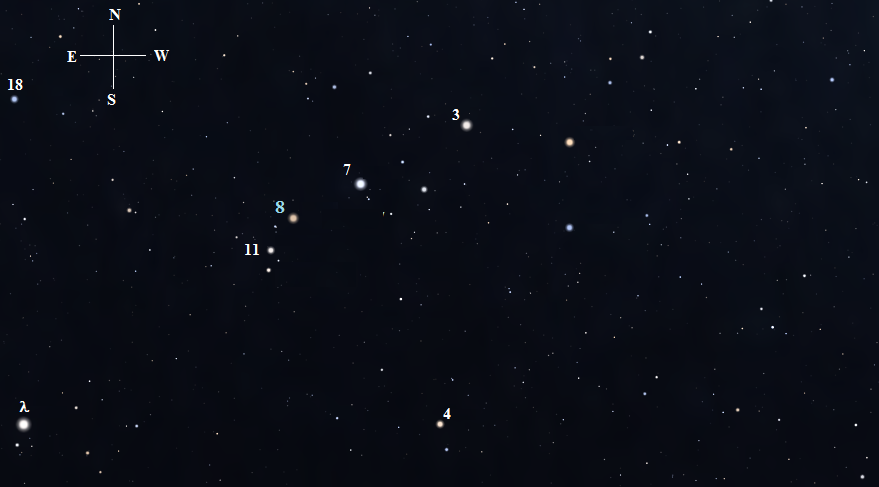
We’re looking now at an image of the upside down Great Bear, caught in his usual springtime position.  Focus your attention on his right rear foot, where you’ll find Tania Borealis designated as Lambda (l) and Tania Australis as Mu (m).  (Stellarium screen image with labels added, click for a larger view).

We’re looking now at an image of the upside down Great Bear, caught in his usual springtime position. Focus your attention on his right rear foot, where you’ll find Tania Borealis designated as Lambda (λ) and Tania Australis as Mu (μ). (Stellarium screen image with labels added, click for a larger view).

We’ll start by centering Tania Borealis in the crosshairs of our finder.  If you look one degree north of it, you’ll find  ENG 43 beaming its 6.7 magnitudes of yellowish light back at you.  From there, we’ll shift half a degree east and take a look at 8.1 magnitude Σ1427.  (Stellarium screen image with labels added, click to enlarge).

We’ll start by centering Tania Borealis in the crosshairs of our finder. If you look one degree north of it, you’ll find ENG 43 beaming its 6.7 magnitudes of yellowish light back at you. From there, we’ll shift half a degree east and take a look at 8.1 magnitude Σ 1427. (Stellarium screen image with labels added, click to enlarge).

ENG 43      HIP: 50505   SAO: 43279
RA: 10h 18.9m   Dec: 44° 03’
Magnitudes: 6.73, 9.37
Separation:  145.2”
Position Angle: 97°  (WDS 2002)
Distance: 67 Light Years
Spectral Classification: G5, G0

This is one of the wider pairs we’ll look at on this tour, so take some to enjoy the view.  You’ll need to narrow your eyes quite a bit on the next two since the separations will become progressively tighter, but your diligence will be rewarded on the last pair (and no skipping ahead – the Sky Gods are watching).

If you look closely, you’ll see a very slight yellow, almost gold tinge, in the primary.  (East & west reversed to match the refractor view, click for a larger version).

If you look closely, you’ll see a very slight yellow, almost gold tinge, in the primary. (East & west reversed to match the refractor view, click for a larger version).

I had a couple of quick views of ENG 43 in both a six inch refractor and a C9.25, but since they were far more aperture than necessary for this pair of stars, I decided to call the 100mm f/13 Skylight from its perch in the house in order to commit its view of these stars to posterity.  It was one of those nights when there was a brief window of opportunity, so I had to sketch fast, a task made more difficult by a thick murk of moisture in the air which swallowed about a magnitude’s worth of light.  So the view in the sketch might be more similar to what would be seen in an 80mm refractor on a good night, but the essentials are still there at least.

Down in the south corner of the field you can see eighth magnitude POP 117, a pair of 8.3 and 9.6 magnitude stars separated by a miserly 0.8 seconds of arc.  I passed on those since they were out of reach even on a good night with a four inch refractor, but be my guest.  The POP refers to G. Popovic, who discovered this pair in 1976.

If you look up the ENG prefix, you’ll find it now refers to Engelmann, but at one time it was used to designate the discoveries of Dr. B. von Engelhardt (page 351, under Dresden), who operated a private observatory in Dresden (Germany), using a twelve inch Grubb refractor.  It was he who actually discovered this pair of stars in 1893.  More on the prefix change can be found in the WDS “References and discover codes” if you scroll down to ENG.

Σ 1427        HIP: 50766   SAO: 43306
RA: 10h 22.0m   Dec: +43° 54’
Magnitudes: 8.18, 8.54
Separation:  9.0”
Position Angle: 214°  (WDS 2012)
Distance: 437 Light Years
Spectral Classification: Both stars F5

Half a degree east from ENG 43 you’ll find an eighth magnitude star that divides easily into two barely separated stars when placed within the circular confines of a medium powered eyepiece.

Quite a contrast in spacing, color, and brightness after the last pair!  (East & west reversed again, click to enlarge the view).

Quite a contrast in spacing, color, and brightness after the last pair! (East & west reversed again, click to enlarge the view).

I stayed with the Skylight 100mm for the sketch of this pair, but I’ve also viewed them in a six inch refractor and a 9.25 inch SCT.  You certainly get a better feeling for the colors of these two stars in the larger scopes, but I prefer the tighter and more delicate jewel-like view displayed in the 100mm scope.  Both stars radiate a light yellow that occasionally flashes hints of gold at you.  This pair, by the way, was discovered in 1829 by Herr von Struve.

Now, back to our second chart above, which is more handy if you click on it here and open a second window.  With Σ 1427 still centered in your finder, if you look closely, you’ll see a dim triangle of stars that starts two degrees to the northeast.  HIP 51290, a 6.35 magnitude sun, holds down the northwest corner, 7.35 magnitude HIP 51603 occupies the southeast corner, and sitting another degree northeast at the peak of the triangle is our goal, Bu 1074, shining its wan orange light at a magnitude of 7.2.  Center it in your finder and sharpen your visual apparatii!

 Bu 1074          HIP: 51846   SAO: 43396
RA: 10h 35.5m   Dec: +45° 39’
Magnitudes: 7.2, 11.2
Separation:  2.5”
Position Angle: 206°
Distance: 510 Light Years
Spectral Classification: K2

And what we have here is another compact package passed down to posterity by that shrewd disciple of the difficult, S. W. Burnham.  I say that because if you look closely at the data line above, you’ll see we’re dealing here with four full magnitudes of difference, which means the secondary is forty times fainter than the primary.  And when you factor in the very close proximity of that secondarial light to its primarial parent, and then toss in the comparatively weak magnitude of the secondary, you suddenly discover you’re adrift in the vague and nebulous terrain of the difficult . . . . . . . which in plain language means this ain’t gonna be easy.

And it wasn’t.

I needed several nights to scrutinize these twin suns of the interstellar medium, mainly because I couldn’t be sure my eyes were seeing what they thought they were seeing.  My weapon of choice was my six inch f/10 refractor, and the best I could eke out of the totally uncooperative seeing conditions was an averted vision view, which is shown in the sketch below:

 Look closely!  You may even need avert your eyes a bit!  The primary was a pleasing shade of orange, but I wouldn’t even begin to hazard a guess as to the secondary’s color.  (East & west reversed again, click for a larger and better view).

Look closely! You may even need avert your vision! (HINT: it’s hiding between the five and six o’clock position).  The primary was a pleasing shade of orange, but I wouldn’t even begin to hazard a guess as to the secondary’s color. (East & west reversed again, click for a larger and better view).

I finally managed to pin the secondary down with direct vision in a 9.25 inch SCT on a night of improved seeing.  A mere puff of light is what it was, every bit as difficult to see in the eyepiece as it is in the sketch above.  I even had to hold my breath to avoid blowing it out (barely an exaggeration), which left me wondering how in the world the eagle-eyed Mr. Burnham was able to measure the separation and position angle.

It was only after all that vision-vexing effort had taken place that I thought of looking up Bu 1074 in Burnham’s A General Catalogue of 1290 Double Stars.  For some reason my mind had leaped to the unfounded conclusion that Burnham had discovered this star with his six inch refractor.  Instead, what I found accompanying his 1889 discovery on page 110 was this notation:

Discovered with the 36 inch.

As in the 36 inch Lick Refractor (here and especially here!).

Which explains why I thought I heard laughter on the nights I was puzzling over this thing.

Not funny, S. W.   Not funny.

But as a reward for going above and beyond the call of the sane and simple, how about something a bit more relaxing for our worn-out optical orbs now?  Feast your eyes on the separations listed below:

SMA 75     (AB is HJL 130, also SHY 216)
HIP: 52469    SAO: 43444
     Magnitudes      Separation    Position Angle           WDS

AB: 5.21,    7.35         288.40”                88°              1874/2012
AC: 5.21,  11.11         150.30”                15°              1907/2002
AD: 5.21,   9.18          382.20”                45°              1958/2012
BD: 7.35,   9.18          261.40”              356°             1907/2002
BP: 7.35, 13.27            83.30”              286°              1907/2002
Distance: 116 Light Years
Spectral Classification:  “A” is F5, “B” is F9, “D” is G1
Status: AB are physically related per SHY

If you go back to our second chart above (also here), you’ll find a line drawn through HIP 51290 and Bu 1074 leads you directly to SMA 75, which stands out conspicuously from the surrounding stellar terrain.

And considering the confined spaces we’ve been restricted to on the last two stars, your first view of this system will be a veritable breath of fresh air:

 This system could almost pass for a small open cluster!  (East & west reversed, click on the sketch for a larger view).

This system could almost pass for a small open cluster! (East & west reversed, click on the sketch for a larger view).

In fact, after the barren nature of most of the Ursa Majorian spaces I’ve explored over the last few months, SMA 75 is an oasis of stars in a desert of darkness.

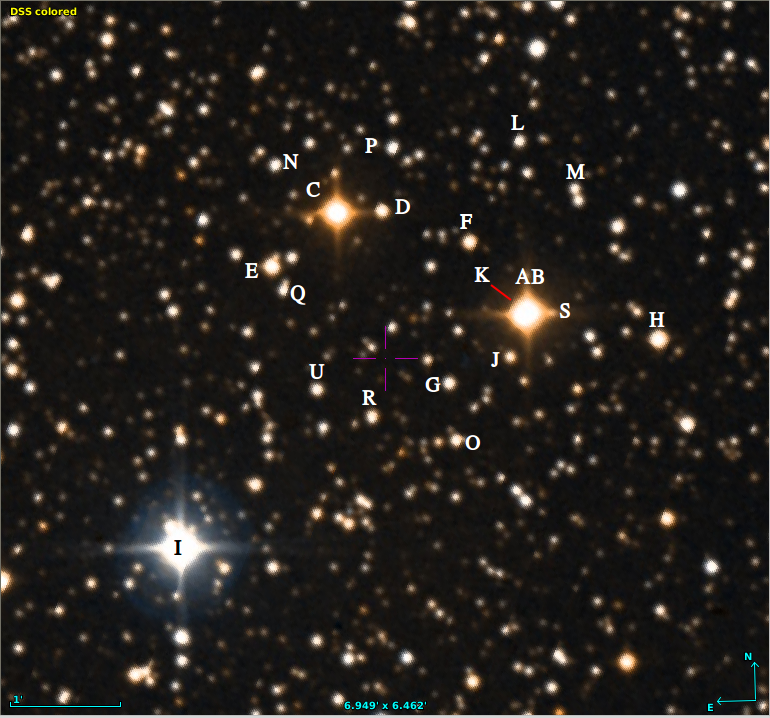
I didn’t have any luck at all with trying to ferret “P” out of the glare caused by “A” and “B”, but it’s there, as this photo shows . . . . . . .

 The image has been rotated and flipped to match that of the sketch above.  (STScI photo with labels added, click to enlarge).

The image has been rotated and flipped to match that of the sketch above. (STScI photo with labels added, click to enlarge).

. . . . . . . and should have been visible in my six inch f/10, so a return visit has already been put on the agenada.

I included the WDS dates of first observation in the data line above to provide some insight into the history of this group of stars, which has undergone rather extensive observation.  The WDS text file on SMA 75 (provided courtesy of Brian Mason of the USNO) shows a total of sixty-six separate observations made by various people from 1874 to 2012.

Click to enlarge!

.   Click to enlarge!

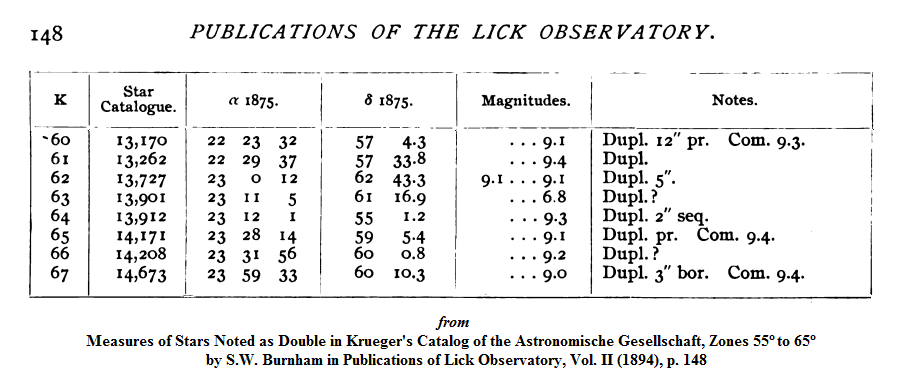
The first observation of the AB pair was made in 1874 by Baron Ercole Dembowski, who is credited with it on p. 111 of S.W. Burnham’s 1906 General Catalogue of Double Stars Within 121° of the North Pole — it’s shown in the thumbnail at the right under Burnham’s catalogue number, 5537.

In 1907, Ejnar Hartzsprung, better known for his contribution to the life cycle of stars portrayed by the Hartzsprung-Russell Diagram, added measurements for AC and AD, as well as taking notice of the position of the star now designated as “P”.   I was able to track down his efforts in this publication, and have included the specific observation below:

Hertzsprung 1907

Note that his observation is also identified with Burnham’s catalogue number, 5537.  Also, the position angle shown for BD (170.4°) is off by 180º (an easy mistake to make in this part of the sky), which was corrected in subsequent publications.

In 1930 these stars were paid a visit by William Marshall Smart, whose initials are now used in the form of SMA to identify this stellar collection.  He contributed a photographic measurement of the AB pair, which was published here.  I’ve included an excerpt from the page showing that observation below . . . . . . .

(Click to enlarge).

. . . . . . which also uses Burnham’s General Catalogue number to identify the star.

And that raises the question of how this system of stars picked up the SMA designation.  Even though Demobowki and Hartzsprung contributed measurements prior to Smart’s photographic measures, Burnham’s catalogue number 5537 stuck as their only identification.   Apparently a decision was made to finally correct that situation — no clue as to the details of it — but at any rate, we now know them as SMA 75 instead of 5537.

I tracked down the 1958 observation shown for the AD pair to the Second Catalogue of the Astronomische Gesellschaft (AGK2), but was unable to shed any light on who performed the measurement of it.

Next time out — if the weather and the seeing will cooperate — we’ll take a tour on the south side of the lovely reddish-orange Tania Australis and see if we can raise our visual acuity to the same level as that of the eagle-eyed S. W. Burnham, double star astronomer extraordinaire.

Until then,  Clear Skies!   :cool:

An Eta-fyingly Close Encounter: Eta (η) Coronae Borealis

I know I’ve said it somewhere before in these pages (let’s see if I can find it . . . . . . . ah, here it is!), but this little curved constellation sure seems to have more than its fair share of tight doubles, which may have something to do with the relatively small slice of stellar real estate it occupies.  Normally I cringe at the thought of a pair of stars separated by less than 1.5”, so in general I avoid even the slightest sight of this Northern Crown.

But every now and then a surprisingly cooperative night comes my way, which was the case a few weeks ago.  I had just spent a very rewarding hour experimenting with how far apart I could pry Phi (φ) Ursae Majoris, and considering I had done better with it than I ever expected, I began looking around the sky for other possible tightly-knit targets.  And then, as if it was a blazing bolide appearing out of the inky black darkness, my eyes were suddenly drawn to Eta (η) Coronae Borealis.

Wedged between Boötes on the west and Hercules on the east, this gracefully curving constellation is one of the few that really resembles its name.  (Stellarium screen image with labels added, click to enlarge).

Wedged between Boötes on the west and Hercules on the east, this gracefully curving constellation is one of the few that really resembles its name.  Eta (η) is shown just to the right of center in a pleasingly warm shade of yellow. (Stellarium screen image with labels added, click to enlarge).

Eta Coronae Borealis (Σ 1937)  (AB is H I 16)           HIP: 75312   SAO: 64673
RA: 15h 23.2m   Dec: + 30° 17’
Magnitudes  AB: 5.64, 5.95   AB,C: 4.98, 13.35   AB,D: 4.98, 11.00
Separations AB: 0.667”         AB,C: 73.7”              AB,D: 217.7”
Position Angles   AB: 191°   (WDS 2013)
.                           AB,C: 359°   (WDS 2006)
                          AB,D:   41°   (WDS 2006)
Distance: 61 Light Years
Spectral Classification: “A” is F7; “B” is G0
Status: Gravitationally linked, orbit can be seen here.

Now I labored rather hard on this double-star-posing-as-a-single-star about a year ago for several nights, so my memory guided me to it right away.  Since it’s a naked eye star under dark skies, I just aimed the ole cream-colored tube of my six inch f/10 refractor in its direction, took a peek into an 18mm Radian (84x), and thar she was again, a wonderful shade of sizzling white with judiciously placed tinges of faint yellow melting into a mouth-watering lemon meringue custard.  Dazzling, delightful, and down-right appetizing.

Having just inhaled the thin upper stratospheric atmosphere of magnification possibilities on Phi (φ) UMa, I knew where I wanted to start – the 18mm Radian was about as far from my destination as Mars is from Miami.  Into the eyepiece box I went and came out with a 3.2mm TMB Planetary, offering what Sir William Herschel would describe as a tempting  475 diameters, better known to us these days as 475x.

Last year when I attempted this, I clearly remember uttering some very un-astronomical-like words, a few of which only used four letters, and none of which were MARS.  This time another four lettered word materialized in my mind as soon as Eta’s image landed in it:  HOPE  -–  with an exclamation point (!) even (!!!) . . . . . . .

. . . . . . . because without straining my eyes, without holding my breath, without even muttering sweet stellar nothings, I could actually see two stars!  OK, they were elongated, and yes, they were draped one over the other – as in overlapping – but still, they were two distinct almost globes of light.

That one word, HOPE, led to a desire to cast my line further out into the dark rippling current of the star-studded night, so I removed the 3.2mm and replaced it with a 2.5mm version cut from the same cylindrical mold . . . . . . .

. . . . . . . which elevated my aim to six hundred and eight of Sir William’s diameters.

 And allowed me to net this wriggling little duo of wiggling light:

Still touching, but only just.  The star image is courtesy of Sky Safari.  (East & west reversed to match the refractor view).

Still touching, but only just. The star image is courtesy of Sky Safari. (East & west reversed to match the refractor view, click for a larger version).

So close!   Arggghhh!  I cast my eyes up into the vacuous night and begged and beseeched and implored the heavens – please! – just one quick glimpse of a thin black line of interstellar nothingness between Eta-A and Eta-B.   I promised the Sky Gods an Ethos I didn’t have, I promised my four-legged observing partner all the dog bones in the pantry —  I even swore (bad choice of words) never to use un-astronomical-like words for the rest of my life!

But it made no difference.

As I sat hunched over the eyepiece, imploring the impossible from the invisible, I could feel my feet sliding on the slippery wet rocks of seeing degradation.  What I mean is the seeing was slipping south faster than a barrel of hapless human hurtling over Niagara Falls, thanks to an approaching cold front swooping in from the Pacific.

RATS!  (Whoops – said I wouldn’t do that).

But just on the off-chance I might reel in some real luck, I slipped a 4mm TMB Planetary into a 2.4x Barlow . . . . . . which brought me 894 diameters of smeared shimmering light with hints of oval-ing globes buried near the center.  It quickly became obvious they were never going to separate — not now.  Maybe if I had been thirty minutes sooner, I could have done it –- but definitely not now.  If I had just been a little less mesmerized by the view and cast my line right away -– but it was way too late now.

I knew darn well I had just missed a very rare chance of splitting this pulsating pair of grasping stars.  Which was all the more frustrating because I was also well aware this is the year to succeed with Eta (η) – because these two luscious globes of creamy white light are slowly moving closer together after this year . . . . . . .

__________________________________________________________________

 Theta  Rho        Theta  Rho      Theta   Rho      Theta   Rho     Theta   Rho
 .     2011                  2012                 2013                  2014                 2015
175.5  0.623     183.5  0.651    191.0  0.667    198.4  0.665     205.9  0.643

(Theta is position angle, Rho is separation)
from WDS Sixth Catalog of Orbits of Visual Binary Stars: Ephemerides

__________________________________________________________________

. . . . . . . not by a whole lot, as you can see, but in the miniscule range of separation this pair of stars inhabits, every thousandth of an arc second counts!

Now if you care to give Eta (η) Cor Bor a try, you can either go for it cold turkey like I did, or you can follow these well thought out instructions suggested by Sir William back in 1781:

 . . . when η Coronae borealis (one of the most minute double stars) is proposed to be viewed, let the telescope be some time before directed to α Geminorum, or if not in view to either of the following stars, ζ Aquarii, μ Draconis, ρ Herculis, α Piscium, or the curious double-double star ε Lyrae.  These should be kept in view for a considerable time, that the eye may acquire the habit of seeing such objects well and distinctly.  The observer may next proceed to ξ Ursae majoris, and the beautiful treble star in Monoceros’s right fore-foot; after these to ι Bootis, which is a fine miniature of α Geminorum, to the star preceding α Orionis, and to η Orionis.  By this time both the eye and the telescope will be prepared for a still finer picture, which is η Coronae borealis.  It will be in vain to attempt this latter if all the former, at least ι Bootis, cannot distinctly be perceived to be fairly separated because it is almost as fine a miniature of ι Bootis as that is of α Geminorum.”

Sir William Herschel: On the Parallax of Fixed Stars: Philosophical Transactions, Vol 72 (1782), pp. 100-101.

At any rate, it’s been an interesting past few weeks.  I’ve gone from a frustrating and de-φ-ing (de-PHI-ing) experience to a considerably more illuminating and η-fying (ETA-fying) experience  ——-  and somehow managed to not become totally π-eyed (Pi-eyed) during the process.  :roll:

Although it is possible I was out in the cold dark damp night just a little too long.

Clear Skies!  :cool:

My Optical De-PHI-ing Adventures, or How to Stretch a Star Apart: Phi [φ] Ursae Majoris (30 UMa)

How do you separate a pair of like magnitude stars with only 0.41 seconds of arc between them with a six inch f/10 refractor?  Well, you don’t.  But like a piece of salt water taffy, you can stretch and streeetch and streeeeetch them until they no longer resemble the original sharply defined object you were gazing at when you started.

First some mathematics, but I’ll keep it simple – we only need to divide a pair of numbers and we’re done.  The Dawes’ limit, a product of the fertile mind of the Reverend W. R. Dawes, states the limit of optical resolution for a given lens is a constant divided by the aperture of the lens.  If you’re measuring the lens in inches, that constant is 4.56; if you’re measuring the lens in millimeters, the constant is 115.8.

In the case of my six inch lens, divide 4.56 by six and you get .76”; or, since that six inches is equivalent to 152 millimeters, divide 115.8 by 152 and you come up with .76” again.  So – theoretically – my six inch lens should be able to resolve a pair of stars just .76 seconds of arc apart, provided the pair is of equal brightness.  It’s even quite possible to exceed the Dawes’ limit – the Reverend did it more than once, which I suspect led him to revise the limit a couple of times.  I haven’t breached the limit, but I did reach it a short time ago with a 60mm f/16.7 lens when I resolved Porrima.  At the time the two stars were separated by 1.95”, which compares quite well with the 1.93” Dawes’ limit for the lens.

So the goal here is not to de-Phi the Dawes’ limit, but to catch the Phi (φ) UMa pair in an elongated state.  Resolution may even be possible, given very good seeing conditions, sharp eyes, and a lens as optically perfect as possible – but don’t bet your Zeiss Orthos on it.

Let’s pin down Phi’s location first, and then get started.

Phi (φ) can be seen here in blue at the left center of this inverted image of the Great Bear, situated south of Upsilon (υ) and northeast of Theta (θ) Ursae Majoris.  (Stellarium screen image with labels added, click on the chart for a larger view).

Phi (φ) can be seen here in blue at the left center of this inverted image of the Great Bear, situated south of Upsilon (υ) and northeast of Theta (θ) Ursae Majoris. (Stellarium screen image with labels added, click on the chart for a larger view).

OΣ 208  (30 UMa, Phi [φ] UMa)            HIP: 48402   SAO: 27408
RA: 09h 52.1m   Dec: +54° 04’
Magnitudes: 5.28, 5.39
Separation:  0.41”
Position Angle: 300.7°  (WDS 2013 — see the Ephemerides of the 6th Orbit Catalog)
Distance: 437 Light Years
Spectral Classification: “A” & “B” are both A3

Considering what we’re attempting to do here, a good place to start is with the first night’s seeing quality.  One word will describe it: POOR.  Or if you want a pictorial point of reference, it was somewhere between a I and a II on this chart.  So even though I didn’t expect much, since the night was clear and the moon was obnoxiously full, I decided I might as well invest an hour in this project.

To start this stretcher-ous adventure at the top of the sky, I reached for a 6mm (253x) Astro-Tech High Grade Plössl, which yielded a round dot of hopping white light.  Then I put the 6mm in a 2.4x Dakin Barlow (608x), and that produced a smeared round dot of hopping white light immersed in an obnoxious glare.  Not having the good sense to know when to quit, I dropped a 4mm AT Plössl into the 2.4x Barlow (894x) and smeared the image a whole lot more, although the hopping white dot of light was still visible – sort of.  So I took the hint and dropped back to 608x, but this time I dug into my seldom used stash and pulled out a 2.5mm TMB Planetary since it has a wider field of view and longer eye relief.

The worst part of this whole exercise was an annoying high frequency hopping that was unaccountably insistent on leaping along an east-west axis.  I turned off the drive on my mount several times to see if there was a link between it and the hopping, but it didn’t make any difference – it was an east-west hop with no hope.

I was also having a problem at 608x (and higher) with the star flaring into a mushy comet if it strayed too far from the center of the field of view, which I suspect was caused by the pin-hole sized openings on both the top and bottom of the AT Plössls.  As long I kept the star centered with the hand controller (you need a darn good polar alignment at these magnifications), I could keep a reasonably sharp image.  The 2.5mm TMB has a similar pinhole opening at the bottom, but the lens at the top is much larger in diameter, providing more latitude with regard to keeping the image centered.  And its longer eye relief was more than welcomed by my no longer vibrant vision.

Regardless of how I tried to compensate for it, the hopping was still horrible.  But with patience – long periods of staring into the eyepiece while sitting rigidly still – I could occasionally capture what amounted to a visual snapshot of the image when the period between hops increased.  Those intervals were never long – maybe several tenths of a second – but with practice, I got better at grabbing that image and digesting it visually and mentally.

I persisted for about an hour, and during that time I had maybe a dozen glimpses of an elongated image along the 120-300 degree axis.  About half of that time, it very much resembled Porrima in a figure-8 configuration – a quivering and slightly smeared figure-8, but nevertheless clearly identifiable.

About an hour later I returned to Porrima to see if I could separate it with a 60mm f/15 Carton lensed refractor.   The seeing had turned to pure mush, so there wasn’t much hope – BUT – what I did see in it looked virtually identical to what I had seen in the six inch f/10 while I was looking at Phi (φ).

So – success of a sort – but certainly not very satisfying.

Two nights later I was back with the six inch f/10 once again under slightly better seeing conditions, about midway between a II and a III.  The erratic hop was still present, but instead of hopping on an east-west axis, it varied randomly – sort of a hip, a hop, and a spinning jump that never landed in the same place twice.  But there were times when the hopping settled down almost long enough to call it staying put, so it was a definite improvement.

I started with the 2.5mm TMB (608x), which gave me a more distinct image than I had seen during the previous session.  At times, I had clear glimpses of a slightly compressed figure eight cursed with a frequent and frantic hop.  I decided to drop back to the 3.2mm TMB (475x), which resulted in a clearer image (much of the blurring and scatter around the image was gone), but the less frantic image had now become a much smaller image, making it harder to detect the dueling dots.  But again, with intense staring, coupled with sitting rigid as a rock, I was able to see an obvious elongation during the relatively calm tenths of a second when the hopping paused for breath.

I was suddenly struck with an incurable itch to experiment, so I slipped the 3.2mm TMB into a 2.4x Dakin Barlow (1140x) and found myself staring at a sphere of smeared light nested in a larger sphere of smeared light, all of it plagued by the ever-present high frequency hopping, with rumors of two stars buried in there somewhere.

So I returned to the bare naked 3.2mm TMB (475x) and contented myself with grabbing quick glimpses of that poor elongated and tortured figure eight.  I sat there for another hour trying to coax a clearer view from the sky gods, but they ignored me.

The following night I found unexpected clear skies over my head, along with seeing that had improved to a solid III.  When I first put Phi (φ) under the TMB’s 3.2mm 475x lens, I noticed immediately the hopping frequency was down to about 25% of what it had been during the previous session.  And in sheer de-PHI-ance of expectation, I could even see a diffraction ring surrounding the shimmering figure eight outline of the two stars!  I had to concentrate very hard because the hopping was still a distraction, but the visible diffraction rings made coaxing a precise focus from the image a much easier chore.  In fact, I caught so many delectable, almost sharp, snapshots of the outline of two distinct touching globes that I couldn’t resist reaching for the 2.5mm TMB (608x) in hopes of cracking the pair apart.

That move doubled the hopping frequency, so I quadrupled my concentration — the momentarily distinct images I had seen at 475x were a mere hope now.  I waged a visual battle to grab Phi’s frantic photons long enough to re-arrange them into a distinct image, but all I could extract was mainly the blurred, smeared, and elongated blob I had seen on the previous two nights.  It was clear the possibility of seeing a black streak between the two stars was hopeless, but occasionally I was so close I could taste it.

Shown below is a graphic of the images I saw during the three nights just described:

Star images courtesy of Sky Safari -- click for a larger view.

Star images courtesy of Sky Safari — click for a larger view.

The magnifications shown at the bottom right of the chart don’t necessarily match the elongated images from left to right — and that’s because of the poor seeing.  The elongated image at the right corresponds to what I saw at 608x on the second night, as well as what I could see at 475x on the third night when the seeing was significantly better.  What I saw at 1140x is impossible to reproduce — fortunately.

There’s a chapter written by Christopher Taylor (pp. 97-136) in Bob Argyle’s Observing and Measuring Visual Double Stars which describes the observational art of sub-arcsecond vision, and it includes this statement:

“The real image is the disk [Airy disk] and the fundamental point about that is that it is often still there even on second-rate nights when the outer envelope of the seeing blur may reach several times the Dawes’ limit.  Though then quite invisible to an observer not specifically trained to work at the diffraction limit, the Airy disk will time and again reveal itself to a trained eye as an intense nucleus buried in the heart of that seeing blur.”  (First edition, 2004, p. 120)

Now there are several pages prior to the quote above which deal with training the eye to see that kind of detail, so there’s more involved than just running out and staring at a highly magnified hopping star for an hour.  I don’t want to mislead anyone into thinking it only takes an hour of practice to penetrate the blur.  In the same way that averted vision improves with effort, or star colors become more obvious after many nights of experience, you have to work hard at this.  I’ve literally spent hours riveted to intimately embracing stars, all of which finally paid a substantial dividend on the paired stars of Phi (φ).

At any rate, what I found during these three sessions was the two dots of light buried in the seeing blur were clearly present when I concentrated very hard on the center of the image.  But it only happened when the frequency of the hopping gyrations slowed enough that I could grab quick, fleeting glimpses.  I’m determined to hold out for a night when I can see a more distinct and more stable image, something similar to a night of average seeing at about 300x or so.  A class I or II night will come along eventually, hopefully this year.

 Until then, clear and calm skies!  :cool:

Four More in Ursa Major: 36 UMa, Σ 1495, Σ 1462, and Σ 1402

When last we left the Great Bear, we were still stuck within the constraining angles of its Bear-muda Triangle.   But it’s time now to wriggle free from the clutching corners of its three-sided grasp and sail into the open expanses of Ursa Majorian space in search of a four-starred rendezvous.   Two of those four rendezvousing stars will genuinely put your star-hopping skills to the test, requiring some intense navigation through relatively dim and unpopulated regions of the sky.   But never fear – with a  little patience and a strong dose of – ahem — four-bear-ance, we’ll round ‘em up.

And just to add some allure to this journey, three of our targets happen to triple stars.

So turn off those GOTO controls, strap yourself in, and lean back – waaaaay back, in fact. This is the time of the year when the Great Bear plods slowly and deliberately across the very top of the celestial vault –  make sure your neck and knees are limbered up and loose or they’ll be lotsa pain to pay later.

If you think you’ve seen this upside down bear before, it’s because you have – he was in the post prior to this one.  Feast your eyes on the area stretched between 36 and 42 Ursae Majoris, which is where we’ll start.  (Stellarium screen image with labels added, click for a larger view).

If you think you’ve seen this upside down bear before, it’s because you have – he was in the post prior to this one. Feast your eyes on the area stretched between 36 and 42 Ursae Majoris, which is where we’ll start. (Stellarium screen image with labels added, click for a larger view).

We’ll begin with 36 Ursae Majoris . . .

. . . so first, let’s locate Merak (Beta [β] UMa), which is at the southwest corner of the Big Dipper’s dipper (see the first chart for reference).  From Merak, extend a line west and slightly north to Upsilon (υ) Ursae Majoris.  About a third of the way from Merak you’ll find 5.15 magnitude 37 UMa hugging the south side of that line, and about a degree southwest of it you’ll spot 4.80 magnitude 36 UMa.  Center it in your finder and peek into your eyepiece now.  (Stellarium screen image with labels added, click for a larger view).

. . . so first, let’s locate Merak (Beta [β] UMa), which is at the southwest corner of the Big Dipper’s dipper (see the first chart for reference). From Merak, extend a line west and slightly north to Upsilon (υ) Ursae Majoris. About a third of the way from Merak you’ll find 5.15 magnitude 37 UMa hugging the south side of that line, and about a degree southwest of it you’ll spot 4.80 magnitude 36 UMa. Center it in your finder and peek into your eyepiece now. (Stellarium screen image with labels added, click for a larger view).

36 Ursae Majoris   (AB is LDS 2863, also HJL 127)   (AC is ARN 4)
HIP:51459    SAO: 27670
RA: 10h 30.6m    Dec: +55° 59’
Magnitudes   AB: 4.88, 8.86      AC: 4.88, 11.62
Separation    AB: 122.50”          AC: 240.60”
Position Angles   AB: 303° (WDS 2012)    AC: 292° (WDS 2003)
Distance: 42 Light Years
Spectral Classification: “A” is F8, “B” is M0
NOTE: All three components share common proper motion and radial velocity per WDS Notes file.

Uh-oh – this looks rather familiar!  Note the slight yellow tinge of the primary.  (East & west reversed to match the refractor view, click for a larger version).

Uh-oh – this looks rather familiar! Note the slight yellow tinge of the primary. (East & west reversed to match the refractor view, click for a larger version).

I think we’ve been deja-vu’d again.  The three members of 36 UMa look suspiciously like the three members of the last triple star in our previous adventure, 23 UMa, which looked suspiciously like another triple star in that adventure, H V 73, albeit with a ninety degree twist to the west — seems to be a whole lot of cloning going on up here.  Whatever the case, real clones or random circumstances, I find myself rather fond of the gentle arcing curves of all three of these star arrangements.

Over at the north edge of the eyepiece you’ll see the eleventh magnitude flicker of HJ 1178, a dim double with magnitudes of 11.71 and 12.24 separated by 5.2″ at a position angle of 119 degrees (WDS 2004).  There’s no spectral information at that link, but judging by the photograph, they both seem to have a weak orange tint.

36 UMa has more than a few three-letter abbreviations attached to it, which should indicate an interesting history, but much of it is tantalizingly vague. The first abbreviation, LDS, refers to the Luyten Proper Motion Catalog, named for Willem Jacob Luyten, a Dutch-American astronomer.  The Washington Double Star Catalog (WDS) shows the first date of observation for the AB pair as 1905, but since Willem was born in 1899, unless he was an astronomical prodigy at the age of six, it was someone else who made the first observation.  However, that observation was apparently recorded in a 1927 Catalog, The Munich Sternwarte.  Although I tracked down the catalog, I couldn’t find anything that resembled a double star measurement.

The second set of initials, HJL, are no help either in unearthing that first observer, since they refer to J. L. Halbwachs, who published a proper motion study in 1986 which included the AB pair.  And the last set of initials, ARN, refer to Dave Arnold, an active contributor to the Journal of Double Star Observers (JDSO) and are associated with the AC pair.  His observations were first recorded in 1991 in The Double Star Observer (Vol 8, No. 5, 2002), a publication which I’ve had no luck in finding.  If anyone can supply a link to that publication, I would be thrilled right to the tips of my focus fingers.

Meanwhile, let’s move on to star number two:

Σ 1495  (H V 111)        HIP: 53750   SAO: 27861
RA: 10h 59.8m   Dec: +58° 54’
Magnitudes: 7.25, 8.84
Separation:  34.1”
Position Angle: 36°  (WDS 2009)
Distance: 626 Light Years
Spectral Classifications: K2, K0

Let’s go back to Merak (Beta UMa) again (here’s that chart) and extend a line north to Dubhe (Alpha UMa).  These two stars are the pointers to Polaris, so this should be familiar territory.  Stop halfway along that line and look into your finder, where you’ll find two faint stars pointing west to fifth magnitude 42 UMa.  The closest to our line is 6.60 magnitude HIP 53951, a K2 class star (orange) — the one beyond it in the direction of 42 UMa is our target, 7.10 magnitude Σ 1495, both components of which are also class K stars.  In fact, there are quite a few class K stars in the area we’re going to cover, so I’ll point them out as we bump into them.

And here’s what you’ll find in the eyepiece of a five inch refractor at 73x:

 The orange-white tints of these two stars are subtle because of their faint magnitudes, but they’re there if you look closely.  The orange hue of the 8.8 magnitude secondary impressed me as a weak imitation of the primary.  (East & west reversed, click on the sketch for a better view).

The orange-white tints of these two stars are subtle because of their faint magnitudes, but they’re there if you look closely. The orange hue of the 8.8 magnitude secondary impressed me as a weak imitation of the primary. (East & west reversed, click on the sketch for a better view).

This is a comparatively dim pair of stars, but their colors help them stand out from the rest of the faint background.  Adding more magnification will bring out the orange hue, but the color is subtle enough that you really need a dark night to see it well – too much moonlight or light pollution will overwhelm the orange tint.

Based on the information in Lewis’s compilation of Struve’s stars, this pair seem to be moving toward each other very slowly:

 If you ignore the first and last observations in this list (Herschel’s and Espin’s), you can see the trend of the two components is toward a gradual decrease in separation.  (Click for a larger view).

If you ignore the first and last observations in this list (Herschel’s and Espin’s), you can see the trend of the two components is toward a gradual, although slightly jagged, decrease in separation. (Click for a larger view).

Sir William Herschel’s first observation of this pair of stars, which is shown below, includes a description of his target as being at the center of three stars forming an arch. . .

Herschel on STF 1495

. . . and if you look at the chart again, you can clearly see what he was referring to — rather striking to think we’re actually looking at the same three star configuration Sir William was looking at 231 years ago.

On to star number three, now, and a chance to put your star hopping skills to the test!

Σ 1462          HIP: 52413   SAO: 27744
RA: 10h 42.9m  Dec: +50° 48’
Magnitudes   AB: 7.41, 10.10   AC: 7.41, 9.60
Separations  AB: 8.00”              AC: 193.30”
Position Angles  AB: 175°  (WDS 2002)   AC: 59°  (WDS 2002)
Distance: 344 Light Years
Spectral Classifications:  “A” & “B” are A3

Here’s our chart again, and we’ll start by going to back to what should be a familiar place by now, Merak.  Pay careful attention or you’ll find yourself looking for this star in all the wrong places.

From Merak, angle south and slightly west two degrees to 5.1 magnitude 44 Ursae Majoris, which is a class K3 star.  Now make another two degree leap in the dark, this time due south, and you’ll spot a line of three faint stars – 6.75 magnitude HIP 53155 and 6.40 magnitude HIP 53157 (a class K2 star) form a tight pair in your finder, both of which point south to 7.0 magnitude HIP 53173.  All three of those stars point south another two degrees to 6.60 magnitude HIP 53134 (another K2 star), which forms a faint triangle with 7.0 magnitude HIP 52495 (class K1) and – at last – our goal, Σ 1462.   If you got this far, you’ve succeeded in negotiating through six degrees of sparsely populated interstellar space, which qualifies you for a position as a junior pilot on the Starship Enterprise.   ;)

And here’s the 95x view in a five inch refractor:

A barren stretch of sky with a distinctive triple star right in the center – east & west reversed once more, click for a larger view.

A barren stretch of sky with a distinctive triple star right in the center – east & west reversed once more, click on the image for a much better view.

We’ve lost the prevailing orange so common in this sector of the sky, and are now looking at a white primary shadowed closely by a mere puff of secondarial light, with a pale shimmer of grayish light just over three arc minutes to their southeast.  And we’ve also lost the arcing triple curve that was a characteristic of 36 UMa and the other two stars mentioned earlier.

In looking at the data in Thomas Lewis’s book mentioned above, you can see quite clearly that the secondary was moving closer to the primary at least through the last observation shown in 1901:

Click on the image to enlarge it.

Based on the 2002 WDS data, it appears the distance between the two stars is increasing once again, which would seem to indicate an orbital situation, but the WDS Sixth Orbital Catalog doesn’t include a listing for Σ 1462.

And as for that distant “C” companion, the first observation of it was made in 1880 by R.S. Ball from the Dunsink Observatory in Dublin, Ireland.

Meanwhile, let’s make another long leap in the dark to our final star.

Σ 1402  (AC is GIR 2)          HIP: 49382   SAO: 27506
RA: 10h 04.9m   Dec: +55° 29’
Magnitudes   AB: 7.91, 8.92   AC: 7.91, 9.60
Separations  AB: 32.70”         AC: 132.30”
Position Angles  AB: 106° (WDS 2010)   AC: 175°  (WDS 2007)
Distance: 6523 Light Years
Spectral Classifications:  “A” & “B” are K5; “C” is G0

Since we’ve been using it as a launching point for this tour, let’s go back to Merak and that line we extended earlier to Upsilon (υ) Ursae Majoris, and this time we’ll go all the way to Upsilon (υ) and stop for a look around.  Here’s that chart once more to keep you on track – pay close attention to it or you’ll end up lost in Lynx.

Extending a line four degrees to the southwest of Upsilon (υ) will take you to 5.25 magnitude Phi (φ) UMa, but we’re not going that far.  Instead, look just a bit shy of two degrees along that line and you’ll see a distinctive triangle of stars formed by 5.05 magnitude HIP 47965 (class M3, and west of the line), 5.95 magnitude HIP 48802, and 5.50 magnitude HIP 49005 (class K5), both of which are on the east side of the line.  That last star forms a triangle with two fainter stars, 7.20 magnitude HIP 48981 (class K1) and 7.65 magnitude HIP 49262.  A one degree leap further south through a barren void will bring you to another faint triangle of stars, with its apex on the opposite side.  7.90 magnitude HIP 49130 anchors the west side of the triangle, 7.20 magnitude HIP 49506 (class K1) occupies the east corner, and sitting innocently in the south corner is our goal, 7.80 magnitude Σ 1402, which just happens to contain two more class K stars!

 Another triple and more orange – again!  (East & west reversed to match the refractor view, click for closer look).

Another triple and more orange – again! (East & west reversed to match the refractor view, click for closer look).

Even though both the primary and secondary are classed as K5, the only color I could detect in the secondary was yellow.  But considering the orange I saw in the primary was rather weak, that really isn’t too surprising.

The AB pair is gradually widening since its discovery in 1830 by Sir John Herschel, and a gradual change in PA is also obvious in the data below from Lewis’s book:

Lewis on STF 1402

.

The AC pair was added in 1991 by P.M. Girard – his observation is shown below, taken from the Webb Society’s Double Star Circular of 1996:

Click for a larger view.

And one thing stands out immediately if you take a comparative look at the data for AC — Girard shows a separation of 80.89”, which clashes with the 132.30” separation measured in 2007 in the WDS. Brian Mason of the U.S. Naval Observatory (home for the WDS) was kind enough to supply me with the observational data for Σ 1402, which shows a Hipparcos-Tycho measurement taken at about the same time as Girard’s – it shows a separation of 132.345” with a PA of 174.5 degrees.  That PA matches Girard’s and the separation matches the 2007 WDS observation (which by the way was made by Dave Arnold, who we came across in 36 UMa).  At any rate, it would appear the 80.89” separation credited to Girard in 1991 is in error.

** ** ** ** ** ** ** ** ** ** ** ** ** ** ** ** ** ** ** ** ** ** ** ** ** ** ** ** ** ** ** ** ** ** ** **

So much for stellar sleuthing through this bear-en interstellar sector south of the Dipper’s bowl.

Special thanks to Brian Mason for supplying me with observational and historical references to 36 UMa, Σ 1462, and Σ 1402, all of which are greatly appreciated.

Next stop?  Who knows – I’ve got my eyes on Phi (φ) UMa, just a few degrees south of where we ended this tour.  It sports a separation of 0.41”, well below my resolving radar no doubt, but there’s promise in the fact that its two stars are virtually the same magnitude – 5.3 and 5.4.  If I can detect an elongation in my six inch f/10, you’ll hear the rousing rattle of my Plössls all over the world!

Clear Skies!  :cool:

In the Lair of the Bear: Tau Ursae Majoris, Σ 1315, and 23 Ursae Majoris

I’m not quite sure what I’m doing way up here, upside down in the bear’s lair . . . . . . .

 (Stellarium screen image, click on the bear to enlarge the view).

(Stellarium screen image, click on the bear to enlarge the view).

. . . . . . .  because this really is not my favorite spot to point a telescope.  Even though the seeing is at its best at the zenith (or at least it’s supposed to be), it’s an absolute pain in the neck . . . . . . .  and the back, and the knees, and other parts of the body that are normally silent until they’re stretched and contorted more than they ever expected to be.

But I think I’m on to something.
I do believe I’ve stumbled onto the Bear-muda triangle.   :roll:

Take a look:

The three stars for this session will all fit very comfortably in the five degree field of view of the typical 8x50 or 9x50 finder, a fact which I discovered only after locating my first target, Tau (τ) Ursae Majoris, which is nailed to the north corner of the triangle shown in gold. 16 Ursae Majoris occupies the south corner of the triangle, with Σ 1315 just inside its north side, and 23 UMa is parked at the east edge. Tau (τ), 16 UMa, and 23 UMa also provide an interesting naked eye sight on a dark, moonless night. (Stellarium screen image with labels added, click for a larger view).

The three stars for this session will all fit very comfortably in the five degree field of view of the typical 8×50 or 9×50 finder, a fact which I discovered only after locating my first target, Tau (τ) Ursae Majoris, which is nailed to the north corner of the triangle shown in gold. 16 Ursae Majoris occupies the south corner of the triangle, with Σ 1315 just inside its north side, and 23 UMa is parked at the east edge. Tau (τ), 16 UMa, and 23 UMa also provide an interesting naked eye sight on a dark, moonless night. (Stellarium screen image with labels added, click for a larger view).

If you care to bear with me here, and can stand a little bit of pain, we’ll grab a telescope and claw our way up to the top of the sky and take a look.  We’ll start with a detailed look at Tau (τ) UMa, which initially caught my attention because the date of the last measurement of the AC pair in the Washington Double Star Catalog (WDS) is 1991.

Tau (τ) Ursae Majoris   (14 UMa)   (AB is H V 73, AC is STU 7)
HIP: 45075   SAO: 14796
RA: 09h 10.9m    Dec: 63° 31’
Magnitudes    AB: 4.68, 10.40    AC: 4.68, 11.50
Separations   AB: 52.80”             AC: 102.60”
Position Angles    AB: 37° (WDS 2003)    AC: 6° (WDS 1991)
Distance: 122 Light Years
Spectral Classification:  A is Am, B is A5

First, let’s look at a sketch of Tau (τ) and it’s two companions:

 “B” was difficult to see in the five inch refractor I used for this sketch, but it was much more obvious when I went back a few nights later and looked at it with my six inch f/10 refractor.  (East & west reversed to match the refractor view).

“B” was difficult to see in the five inch refractor I used for this sketch, but it was much more obvious when I went back a few nights later and looked at it with my six inch f/10 refractor. (East & west reversed to match the refractor view, click on the sketch for a larger image).

The seeing on the first night I looked at this pair was rather poor, so between that and the five inch refractor I was using, “B” was mainly an averted vision affair at first – not helped in the least by a 70% waning moon that was located directly behind me.  The primary appeared to be yellow-white, with a very slight tinge of orange in it at times, not at all a good match with the its spectral classification of Am.  However, that “m” refers to a higher level of metal content (scroll down to table of Peculiar Spectral Codes) in the star than normal, so it’s possible that characteristic might contribute to the star’s slight orange tint.  That hint of orange was also visible when I looked at Tau (τ) later with a six inch refractor.

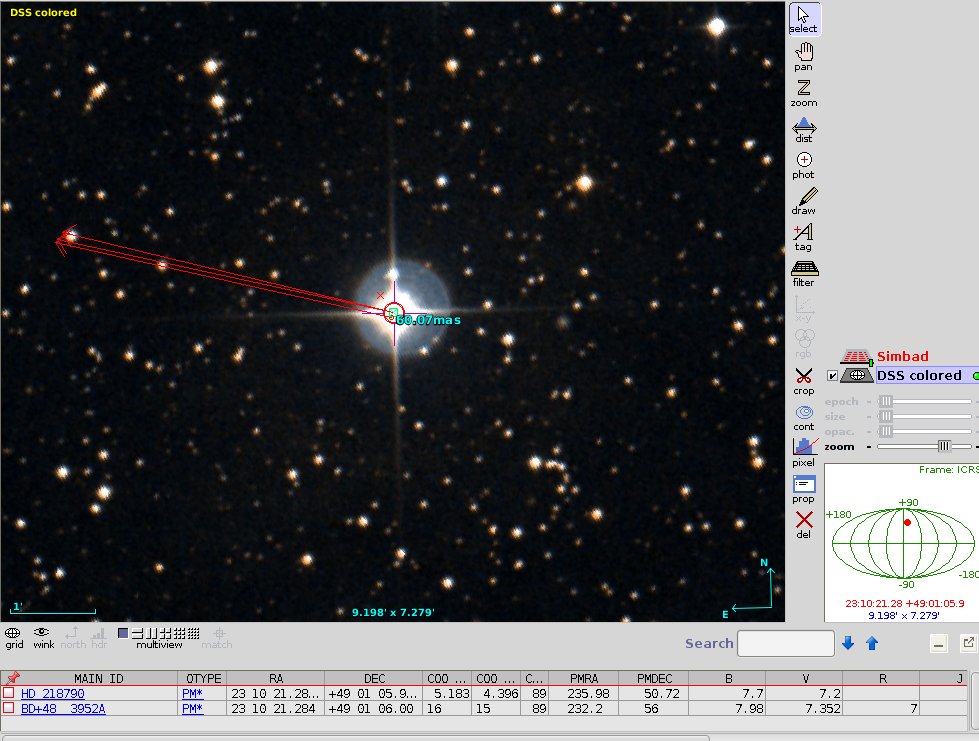
When I first came across the 1991 observation date of Tau’s AC pair, I found myself wondering how much change there had been in the last twenty-two years.  The WDS shows the proper motion of the primary (“A”) as +098 and -056, which translates into .098” per year east and .056” per year south.

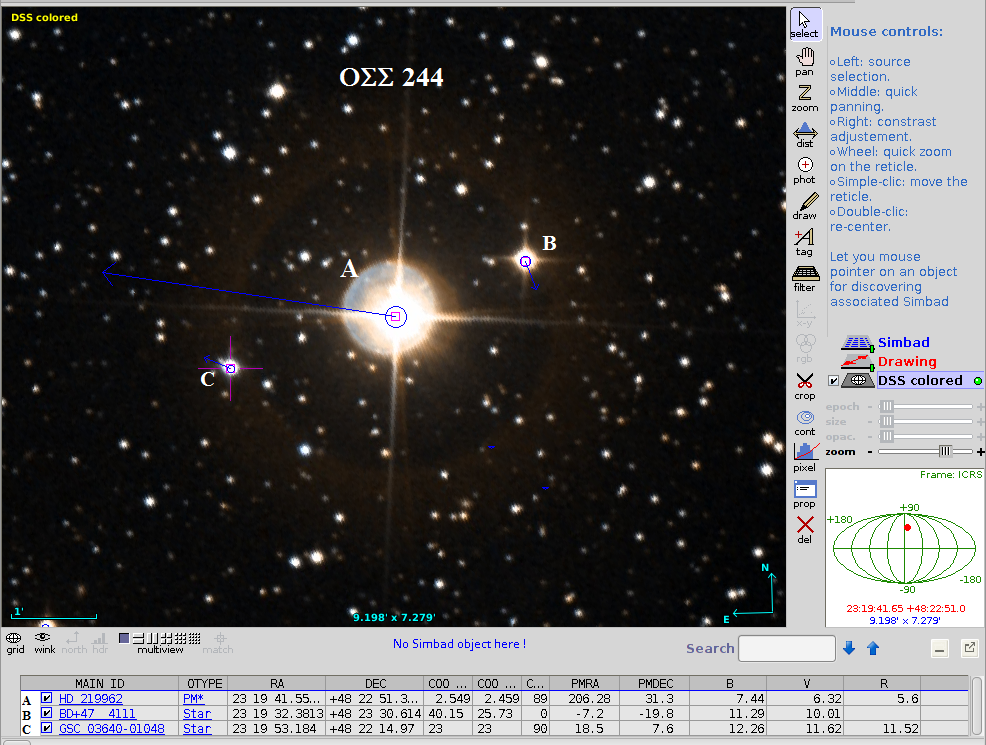
Aladin plot of proper motion of the primary on a 1999 photo of the three stars.  Note that this is a correct image view, meaning north is at the top, east at the left.  (Click on the image for a larger view).


Aladin plot of proper motion of the primary, which is the longest of the red arrows on the chart (the shorter arrows are unrelated to the Tau system).   Note that this is a correct image view, meaning north is at the top, east at the left.


That motion is considerably higher than average, so I decided to take a shot at measuring it with a Celestron astrometric eyepiece . . . . . .

. . . . . . which turned out to be a rather difficult task because of the faint magnitudes of “B” and “C”, very poor seeing, and a steady 15 to 20mph wind.   I went back again a week later under less windy skies and produced a second set of measures which were only slightly different than the first, surprising in consideration of how poor the conditions were the first night.  Averaging the two nights of figures, I came up with a separation for the AB pair of 51.97″ at a position angle of 35 degrees — the AC pair measured 129.93″ with a PA of 7.8 degrees.

The change in “C” is much more significant than that of “B”, which indicates at least one of those two stars also has significant proper motion.  There’s a note in the WDS on the topic which sheds some light on this: “AB: Optical pair, based on study of relative motion of the components.”  So that points to “C” as being the one with a healthy rate of motion, perhaps as much as that of the primary.  At any rate, the change in separation from 102.60″ in 1991 to 129.93″ is considerable.

Let’s slide south now along our triangle to Σ 1315, which is hugging the north side of 16 Ursae Majoris.

Σ 1315  (H N 79)                    HIP: 45206   SAO: 14808
RA: 09h 12.8m    Dec: +61° 41’
Magnitudes:  7.33, 7.65
Separation:  24.7”
Position Angle: 27° (WDS 2012)
Distance: 330 Light Years
Spectral Classification: A0, A0

Sir William Herschel found this pair in 1791, although he didn’t publish his data until 1821:

Herschel on STF 1315

His description of the stars as “4th class, near, equal” (4th class refers to pairs with separations of 15” to 30”) fits well with this pair, as do his coordinates for 1791, but his separation and position angle don’t match up at all with Σ 1315.

Here’s what this pair of stars looks like today:

 I’ve moved Σ 1315  to the northwest side of the sketch in order to include 16 Ursae Majoris for reference.  (East & west reversed, click on the sketch for a larger view).

I’ve moved Σ 1315 to the northwest side of the sketch in order to include 16 Ursae Majoris for reference. (East & west reversed, click on the sketch for a larger view).

Click on the image for a larger view.

Click on the image for a larger view.

Not the most rousing pair of stars in the sky, obviously, but I think they would do better in a 90mm to 100mm scope instead of the five inch I was using.  I could only detect white in them, which was the same thing seen by Lewis in his description of them, as seen at the right.

16 Ursae Majoris, on the other hand, adds a bit of life to the field, which is why I included it.  It’s a 5.19 magnitude star located at a distance of 63.8 light years according to the information available in Sky Safari.  The F9 spectral class assigned to it matches up rather well with the white color/slight yellow tinge I saw in it.

Now let’s move up to the east edge of our triangle and return to the triple star world.

23 Ursae Majoris (Σ 1351)  (H IV 29)  (Sh 371)                HIP: 46733   SAO: 14908
RA: 09h 31.5m    Dec: 63° 04’
Magnitudes   AB: 3.65, 9.19    AC: 3.65, 10.40
Separations  AB:  23.20”         AC: 105.20”
Position Angles    AB: 269° (WDS 2003)      AC: 232° (WDS 2003)
Distance: 76 Light Years
Spectral Classification: A and B are F0

When I first cast eyes on this trio I was immediately struck by the déjà vu view.

A triple beauty with a slight hint of yellow hiding in the primary.  (East & west reversed again, click on the sketch for a better view).

A triple beauty with a slight hint of yellow hiding in the primary. (East & west reversed again, click on the sketch for a better view).

23 UMa bears a strong resemblance to Tau (τ), except that it’s been rotated ninety degrees to the west.  The similarity is both striking and uncanny – not surprising, actually, since we’re still within the unpredictable confines of the Bear-muda triangle.   “B” is tucked in closer to the primary in this case, but “C” is located at about the same distance as Tau’s “C”.

William Herschel was here, too, and left this description in his 1782 catalogue:

Herschel on 23 UMa

He saw red again where others haven’t, but as I’ve mentioned several times before, I think that has to do with the speculum coating used on the mirrors of his time.  He also recorded his measurements here, which when taken with those listed in Lewis’s compilation of observations of Struve’s stars, shows a very gradual increase in separation and a change in position angle toward the west:

Click on the page for a larger view.

Click on the page for a larger view.

The discovery of “C” is something of a mystery.  John Herschel mentions a 12th magnitude star at a distance of 80” in his Sixth Catalogue (p. 199), as shown below:

 Click for a larger view.

Click for a larger view.

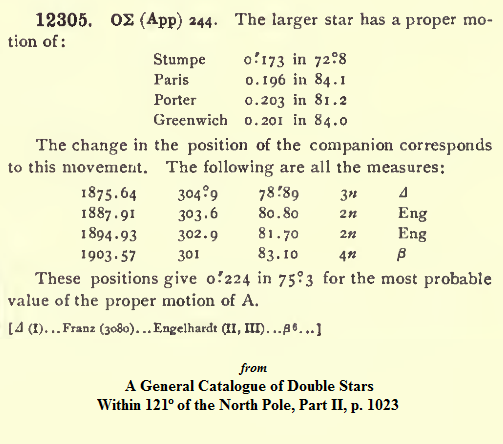
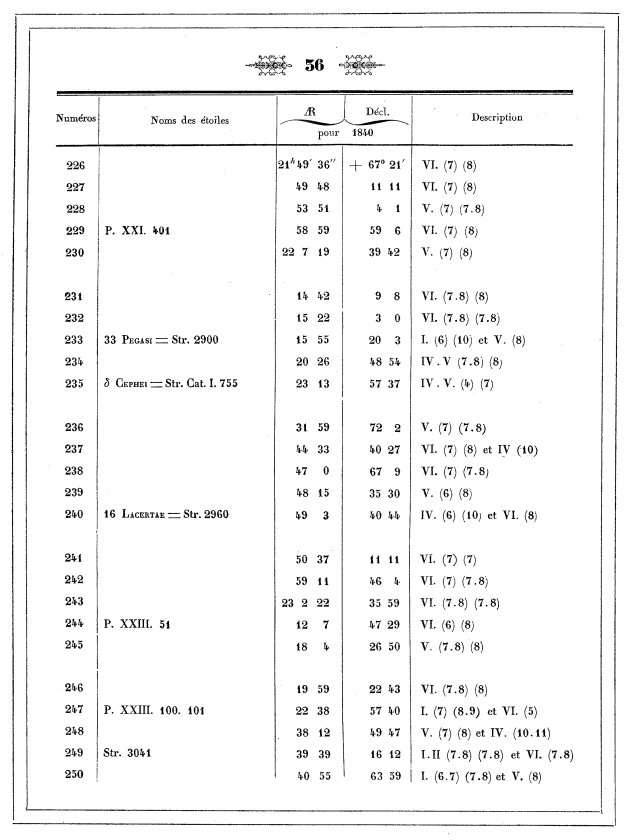
But the WDS shows a date of 1879 for its first measurement, leading me to suspect S. W. Burnham.  However, in looking through volume two of his 1906 A General Catalogue of Double Stars within 121° of the North Pole, on page 547 he credits V. P. Engelhardt of the Dresden with the measurement.

So, that’s our trip through this remote corner of the Bear’s lair.  There’s another interesting triple star nearby, also with a resemblance to Tau (τ) and 23 UMa, which we’ll leave dangling while I stir up the clouds with a long pole and prod them to move somewhere else.

Clear Skies (sooner or later)!  :cool:

A Five Star Collection in Perseus: MLB 1036, Σ 533, OΣ 81, DOO 7, and . . . ???

If you find yourself roaming the southeastern sector of Perseus some dark and starry night, you’ll encounter some strangely named stars — such as Menkib and Atik — and some oddly named objects — such as B5 and LDN 1470 — not to mention the very extended, very ghostly, and pretty much very invisible California Nebula (at least to eyes without CCD implants).

And if you cast a chart-bound glance (chart 13 of the S&T Pocket Atlas, chart 7 of the Cambridge Double Star Atlas) about five degrees east and somewhat south of Menkib, you’ll find your eyes settling on a rather unlikely trio of north-south aligned stars — lined up like buttons on a coat, they are — beckoning for your attention.  The two outer suns at the opposite ends of that alignment are multiple stars.  Each of them is accompanied by an adjacent multiple system, one a little further north, the other a little farther south — and all of them are visible within a mere half-degree eyepiece field of view.  And sitting right there in the middle is the fifth star mysteriously missing from the title above, 55 Persei, a 5.73 magnitude single blue-white (B8) star at a distance of 450 light years from us — sort of the glue for the whole view.

But instead of talking about them, let’s go look.

 Looks like we’ve caught Perseus lying down on the job again, which is pretty much his normal position on a late winter or early spring evening.  Our goal is 55 Persei, which lies about five degrees out beyond Menkib.   (Stellarium screen image with labels added, click for a larger view).

Hmmm — we seem to have caught Perseus lying down on the job again, which is pretty much his normal position on a late winter or early spring evening. Our goal is 55 Persei, which lies about five degrees south and east of Menkib. (Stellarium screen image with labels added, click for a larger view).

We’ll zoom in a little closer now, and if you look very closely you’ll catch the faint outlines of the California Nebula just north of Menkib.  If you extend a line about four degrees east and slightly south of Menkib, it’ll lead you to 4.90 magnitude 54 Persei, and lying a little less than a degree beyond that is 5.73 magnitude 55 Persei.  With Σ 533 to its north and OΣ 81 to its south, the view in a 6x30 or 8x50 finder is downright attractive.  (Stellarium screen image with labels added, click to enlarge the view).

We’ll zoom in a little closer now, and if you look very closely you’ll catch the faint outlines of the California Nebula just north of Menkib. If you extend a line about four degrees east and slightly south of Menkib, it’ll lead you to 4.90 magnitude 54 Persei, and lying a little less than a degree beyond that is 5.73 magnitude 55 Persei. With Σ 533 to its north and OΣ 81 to its south, the view in a 6×30 or 8×50 finder is downright attractive. (Stellarium screen image with labels added, click to enlarge the view).

Let’s start by taking a look at photo of this area, which will give you a good idea of the relative positions of the four multiple stars we’re going to look at on this Persean sojourn:

STScI photo, east & west reversed to match the refractor view, click for a larger version.

STScI photo, east & west reversed to match the refractor view, click for a larger version.

And now we’ll take a look at a sketch of the area (and lose most of those background stars visible in the photo), tilted to match Perseus’ sliding-into-the-west-reclining-position:

Our three main stars are still lined up like buttons on a coat, but now their north-south alignment has been rotated to the left about forty-five degrees.  (East and west reversed to match the refractor view, click for a larger version).

Our three main stars are still lined up like buttons on a coat, but now their north-south alignment has been rotated to the left about forty-five degrees. (East and west reversed to match the refractor view, click for a larger version).

We’ll start in the north and zero in on Σ 533 and MLB 1036:

Σ 533 (STF 533)   (AB is H IV 72)         HIP: 20570   SAO: 57211
RA: 04h 24.4m   Dec: +34° 19’
Magnitudes    AB: 7.30, 8.49      AC: 7.30, 12.0
Separations   AB: 19.80”            AC: 107.20”
Position Angles   AB: 61°  (WDS 2011)    AC: 193°  (WDS 2001)
Distance: ?????
Spectral Classification: A is B8, B is F2

MLB 1036             (No HIP or SAO numbers assigned)
RA: 04h 24.6m   Dec: +34° 21’
Magnitudes: 11.0, 11.5
Separation:    5.1”
Position Angle: 217°  (WDS 2007)
Distance:  ?????
Spectral Classification:  None assigned

I placed Σ 533 and MLB 1036 at the north edge of this sketch in order to include 55 Persei in it as a point of reference.  MLB 1036 is at the southwest corner of the faint rectangle of stars north of Σ 533.  (East & west reversed to match the refractor view, click for a closer view).

I placed Σ 533 and MLB 1036 at the north edge of this sketch in order to include 55 Persei in it as a point of reference. MLB 1036 is at the southwest corner of the faint rectangle of stars north of Σ 533. (East & west reversed to match the refractor view, click for a closer view).

You’ll find the AB pairing of Σ 533 is an easy split (visible even in an 8×50 finder), but you may have to stretch a bit to catch the twelfth magnitude “C” companion, depending on what aperture you’re using.  The primary and secondary are both a very obvious blue-white, although Sir William Herschel, who was the first to record an observation of them (on September 7th, 1782), seems to have seen reddish-white in the primary and pale red in the secondary:

Herschel on STF 533

I suspect the speculum coating on his mirror had something to do with his perception of color, since both stars are a long way from red as far as their spectral class is concerned.  You can see he also took note of the lineup of three stars in the field of view, but seems to have missed the primary-secondary configuration of OΣ 81, the southernmost of the three stars, since it’s absent from his 1784 catalog (scroll down the sixth title on the list).

One other puzzle I ran into was the absence of a distance for Σ 533.  I searched all the usual sources (WDS, Simbad, Bright Star Catalog, Stellarium, Sky Safari) and came up with nothing, which is rather surprising for a seventh magnitude star.

MLB 1036 CroppedMLB 1036, on the other hand, is as difficult to separate as Σ 533 is easy.  In fact, the little devil defied me in three determined attempts to pry it apart — so much so that I began to doubt whether I was wrestling with the correct star.  I finally had to go back and refer to the STScI photo above to make sure — and sure enough, when I enlarged the photo (at the right), I could see an elongation pointing somewhere close to the 217 degree position angle listed for it in the WDS.  I’ve split fainter pairs in that five arc second range without much problem, but this pair was as uncooperative as a cloudy night.  Maybe I was just holding my mouth the wrong way.

Click to enlarge.

Click to enlarge.

The letters MLB refer to the discoverer of this pair, W. Milburn, who we ran into this past autumn when looking at another of his discoveries, MLB 36, also a tough pair to wedge apart.  You can see his original observation by clicking on the thumbnail at the right, which is from this source.

Let’s slide down to the south section of our field of view now and look at our other pair of multiple stars (and for reference, here’s that previous sketch of the whole field once again).

OΣ 81  (STT 81)  (56 Per)      HIP: 20591   SAO: 57216
RA: 04h 24.6m   Dec: 33° 58’
                       Magnitudes        Separation      Position Angle     WDS
STT 81       AB:  5.84,   9.25            4.30”                     16°               2007
BAS  4  Aa, Ab:  5.77,   9.00            0.40”                  306°               1999
BAS  4  Ba, Bb: 9.60, 11.30            0.60”                   292°               2002
Distance: 136 Light Years
Spectral Classification: F4

DOO 7          (No HIP or SAO numbers assigned)
RA: 04h 24.8m   Dec: +33° 53’
Magnitudes   AB: 10.71, 11.20    BC: 11.20, 11.70
Separations  AB: 46.40”               BC: 3.30”
Position Angles  AB: 212°  (WDS 2011)   BC: 216°  (WDS 2001)
Distance: 45 Light Years
Spectral Classification: A3

 OΣ 81 is in the center of this field of view, with 55 Persei moved to the north edge now.  Two of the three components of DOO 7 stand out well here, even though they’re 11th magnitude stars.  The “C” component is too close to “B” to be seen here.  (East & west reversed to match the refractor view, click on the sketch to enlarge it).

OΣ 81 is in the center of this field of view, with 55 Persei moved to the north edge now. Two of the three components of DOO 7 stand out well here, even though they’re 11th magnitude stars. The “C” component is too close to “B” to be seen here. (East & west reversed to match the refractor view, click on the sketch to enlarge it).

OΣ 81 is quite a bit tougher than Σ 533 to split — the senior Struve’s discovery surrenders without the least fight, but Otto’s eighty-first discovery (in 1847) forces you to come after it.  I had no luck at all with the magnitude 9.25 secondary on the first night I looked at it, even in a six inch scope, because of atrocious seeing.  There was so much vibration in the eyepiece even at low magnification that I could have sat there all night and never had the first hint of its duplicity.  The second and third nights were much better, with the secondary hovering like a dust mote just out of the primary’s reach — really a pleasing view after the frustrations of the first night.  I didn’t see any hint of a colorful hue creeping into the white primary here, which was the case with all the stars on our list tonight.

As for DOO 7, as the sketch shows, the 10.71 and 11.20 magnitude primary and secondary are very obvious.  “C”, on the other hand, is just a plain pain.  It’s only half a magnitude fainter than “B”, but it’s located claustrophobically close, especially when you consider the weak magnitudes we’re dealing with here.  Fortunately the 216 degree position angle of BC is almost a perfect match for that of  the AB pair at 212 degrees, which provides you with a pointer of sorts.

DOO 7 croppedIt took several attempts, but I finally managed a few very weak glimpses of “C” with a 6mm Astro-Tech Plössl (253x).  There wasn’t much light left by the time I worked my way up to that magnification, though, so it was far from a satisfying view.   It should be possible to do better when Perseus is positioned closer to the zenith, as opposed to the about halfway-to-the-horizon location I where I found it on that night.  If you enlarge the STScI photo above considerably, as shown at the right, you’ll see a very, very slight elongation in the “B” companion.

Click to enlarge.

Click to enlarge to full size.

This triple star was first discovered and measured in 1900 by Eric Doolittle when he was the Director of the University of Pennsylvania’s Flower Observatory in Philadelphia.  In 1901 he published Measures of 900 Double and Multiple Stars made with the Eighteen Inch Refractor of the Flower Observatory (that link to the book will take about a minute to load) which included on page eight a list of twenty-two systems he discovered while compiling his measures.  Number seven on that list, which can be seen at the right, is DOO 7.

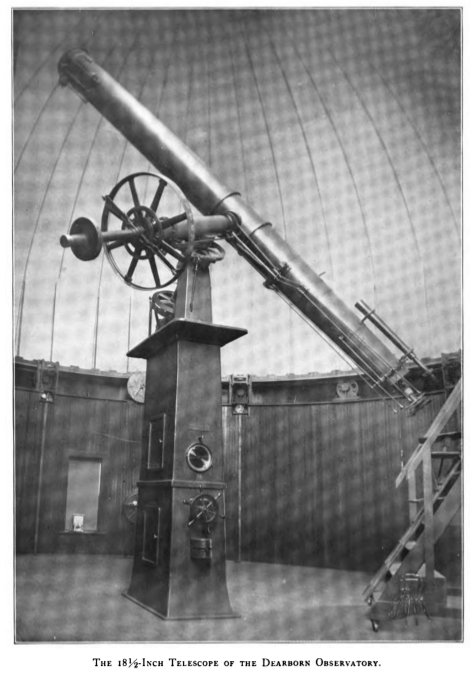
The eighteen inch refractor he was using, which was equipped with the largest Brashear objective of that time, can be seen here, and a short history of the Flower Observatory can be found here.  In the book referred to above, he mentions he was able to measure pairs with that refractor as faint as fourteenth magnitude, and on good nights could resolve stars as close as 0.21”  . . . . . . .  which should give you something to shoot for on a night when you’re looking for something to do.

In the meantime, some of the other Persean stars on Mr. Doolittle’s list have ignited a smoldering curiosity which should be bursting into flames six months from now, so I’ll see if I can work my way back again in late August or early September when Perseus returns to the zenith.

Meanwhile, Clear Skies!  :cool:

A New Double Star that’s Delectably Close: WISE J104915.57-531906

First, to be perfectly clear, we’re dealing with a pair of brown dwarfs here — which are still stars after all, although admittedly they inhabit the somewhat vague terrain between conventional stars and large exo-planets (more on that in this Sky and Telescope article).  But there’s something particularly arresting about this pair of diminutive objects, at least distance wise.

Which is:  they’re located a mere 6.5 light years away.

And that makes them the third closest known star system to us.

The closest known star to us happens to be a four star system.  Alpha Centauri A and B (or Rigel Kent) is located 4.4 light years away, and its twin companion, Proxima Centauri (Ca, Cb), is slightly closer at a distance of 4.2 light years.  Second closest is the restless and rapidly moving Barnard’s Star, at a distance of six light years.

Tempting as it may be to race out under the stars with a telescope to see this pair, don’t.  Their distance is just a bit deceiving.

WISE J104915.57-531906 was first discovered as a single star on a map of the entire sky compiled by NASA’s Wide-field Infrared Survey Explorer (the source of the WISE prefix) by Kevin Luhman, an associate professor of astronomy and astrophysics at Penn State University, due to its rapid proper motion (an animation of its motion can be seen here).   It was only when the Gemini South telescope in Chile was aimed at the star in order to obtain a spectrum of it that it was discovered to be two stars, not one.

The best current source of information on this pair is the Penn State Science press release, which is at the link above that contains the animation of the proper motion.

And, since WISE J104915.57-531906 isn’t a back yard telescope object, here’s a peek from the above press release:

Photo  Credit: NASA/JPL/Gemini Observatory/AURA/NSF

Photo Credit: NASA/JPL/Gemini Observatory/AURA/NSF (Click on the image for a larger view).

Follow

Get every new post delivered to your Inbox.

Join 57 other followers